


After a year in which many of Bitcoin's prominent 2025 calls turned out to be off the mark, 2026 predictions are being framed as a range of scenarios rather than a “goal.” Mostly bullish, but there is also a long bearish tail extending to $10,000.
The Wu Blockchain roundup, released on December 29, argued that while market tolerance for target price narratives has declined since last year's “collective failure,” major banks, asset managers, and industry executives are still putting forward numbers and models for what could drive Bitcoin through 2026.
The center of gravity is within a well-known range, built around institutional allocations and spot ETF channels, approximately $150,000 to $250,000 by the end of 2026. In contrast, bears are relying on macro tightening, slowing demand, and broken technical structures, with downside scenarios centered around $70,000, $56,000, $25,000, and the outlier $10,000.
Bullish prediction for Bitcoin price in 2026
Fundstrat's Tom Lee repeatedly pointed to $200,000 to $250,000 by the end of 2026 and argued that the dynamics of the cycle could be reshaped through institutional allocation and, in particular, expanded piping to facilitate ETF representation. This framework sits alongside more tactical notes within the same shop. Sean Farrell, head of digital asset strategy at Fundstrat, warned of the risk that BTC could fall by $60,000 to $65,000 in the first half of this year, ETH to $1,800 to $2,000, and SOL to $50 to $75 in the first half of 2026.
Leaders in the crypto industry are also achieving six-figure results. Ripple CEO Brad Garlinghouse said during a Binance Blockchain Week panel discussion with Solana Foundation Chairman Lily Liu and Binance CEO Richard Teng that he expects BTC to reach $180,000 by the end of 2026.
Related books
On the banking side, JPMorgan's Nikolaos Panigirtzoglou's team used a volatility-adjusted BTC-to-gold relative valuation framework to peg the “theoretical price/implicit fair value” at nearly $170,000, positioning this as an implicit upper bound in the model for the next six to 12 months rather than a hard year-end target.
Standard Chartered, once one of the more aggressive bulls, has been revised down significantly. We currently expect it to be around $100,000 by the end of 2025 and $150,000 in 2026, citing a weak market and fading drivers, including lower DAT purchases and slower ETF inflows.
That $150,000 neighborhood is crowded. Bernstein reiterated his 2026 target of around $150,000, arguing that this drawdown does not end the bull market and that the cycle is increasingly being extended by institutional capital rather than being constrained by the pace of the four-year halving.
Katherine Dowling, president of Bitcoin reserve firm BSTR, also pointed to $150,000 by the end of 2026, linking the paper to possible monetary easing such as regulatory clarity in the US, the expected end of QT, interest rate cuts, and some major banks allowing advisors to recommend Bitcoin ETFs with recommended allocation ranges of around 1% to 4%.
Citigroup's framework was more explicitly scenario-based. The value of the bitcoins on the note was about $88,000, which Citi predicted would rise to $143,000 over the next 12 months. Approximately 62% increase. Based on expected ETF inflows and potential US digital asset legislation. We set a key support level at $70,000, with a bearish scenario around $78,500 and a bullish scenario of $189,000 if institutional and retail participation increases meaningfully.
Arthur Hayes linked the 2026 range to monetary policy semantics. In his Dec. 19 essay, “Words of Love,” Hayes focused on the Fed's “Reserve Management Purchases” (RMPs), arguing that they are effectively QE by another name, and suggesting that Bitcoin could top around $124,000 in 2026 and test the ~$200,000 level as global money creation accelerates.
Related books
Asset management companies had small numbers and strong direction. Grayscale's 2026 Outlook predicts a new record high in the first half of 2026, citing sustained institutional demand and a gradually clarifying U.S. regulatory environment. In “The Year Ahead: 10 Crypto Predictions for 2026,” Bitwise argued that 2026 is likely to be “in the bulls’ camp,” arguing that institutional adoption and regulatory progress could outweigh the usual late-cycle reactionary narrative tied to a four-year rhythm.
Bearish prediction for Bitcoin price in 2026
The bear case in the Wu Blockchain summary is not a single theory, but multiple failure modes.
CryptoQuant argues that demand growth has slowed enough that Bitcoin may already be in a bearish phase, with a near-term rally toward ~$70,000 near the model realized price and a deeper pullback toward ~$56,000 expected to become more likely in the second half of 2026 if institutional demand weakens and derivatives risk appetite weakens.
Veteran trader Peter Brandt focused on technical structure rather than demand. He warned that the parabolic growth structure has broken down, and based on historical cyclical behavior and the idea of ”exponential decay” of successive bull markets, a drawdown of up to 80% from all-time highs could point to a downside threshold of up to $25,000.
The most extreme claim comes from Bloomberg Intelligence strategist Mike McGlone, who warned that a macro shift to “post-inflationary deflation,” tight liquidity, and a widespread reset of speculative assets could cause Bitcoin to fall by about 88% to 90% from its all-time high to around $10,000 in 2026.
Barclays and VanEck avoided a clear target, but reached a similar tone. Absent a major catalyst, 2026 could be flat to weak due to lower spot trading volumes and weaker retail participation. VanEck said it's been a year of “consolidation” with more digestibility than breakout, with opportunities shifting to secondary developments such as the mining economy and stablecoin payments rather than aggregate price levels.
Taken together, the 2026 map is more of a stress test than a consensus trade. If the ETF and institutional channels continue to compound and policy tailwinds materialize, six numbers remain the mode forecast. If demand stalls or macro liquidity tightens, the lower end of the market argument ($70,000, $56,000, $25,000, even $10,000) will be just as important for positioning as the upper end of the bulls' range of $150,000 to $250,000.
At the time of writing, BTC was trading at $88,027.
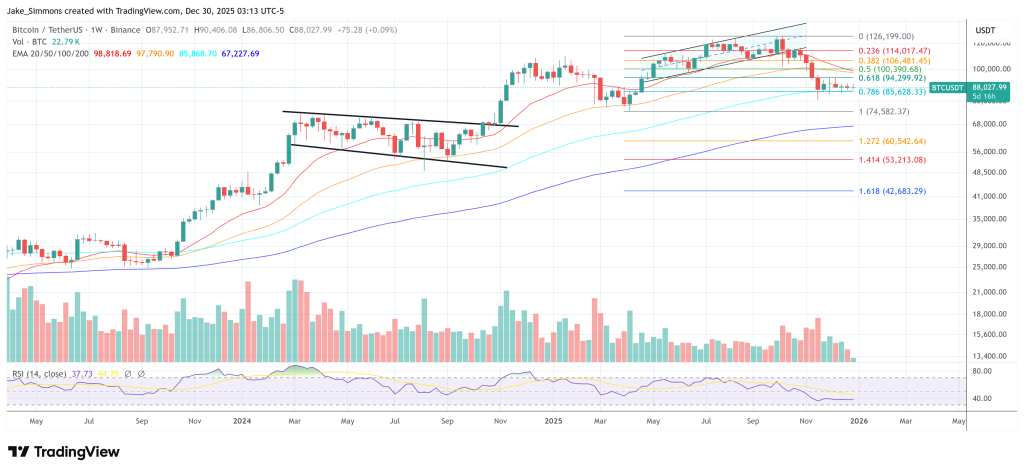
Featured image created with DALL.E, chart on TradingView.com
