

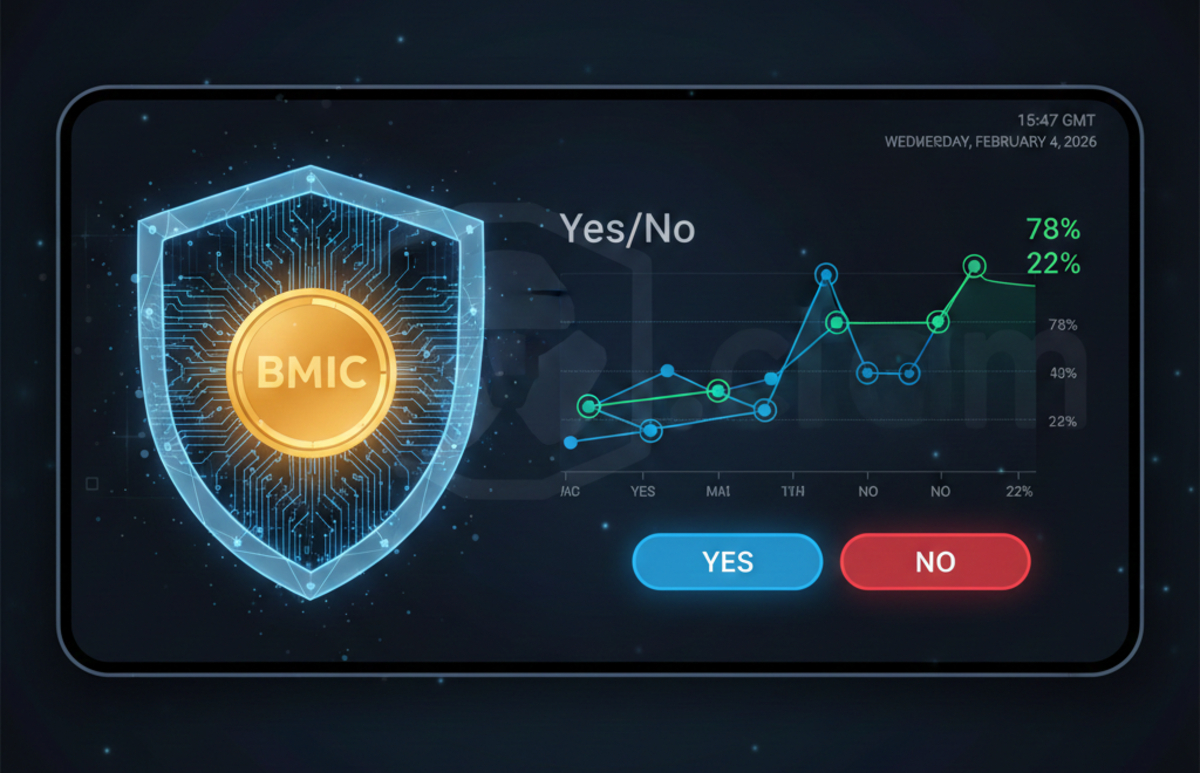
The race to dominate the prediction market sector is truly crowded.
Following the huge success of decentralized platforms like Polymarket, Crypto.com has officially announced its strategy to capture a piece of the binary outcome economy. Exchanges' moves to integrate predictive-style mechanics and consider “up/down” options and event contracts signal a major shift.

This changes how Centralized Exchanges (CEX) views the intersection of gambling, trading, and information markets.
Why is this important?Simple: Examining sectors beyond niche DeFi circles. The entry of top-level regulated exchanges into the fray will bring increased liquidity, improved user experience, and ease of implementation for retail participants who find on-chain betting cumbersome.
The move effectively democratizes hedging against real-world events, from Fed rate cuts to election results. But there's a catch. Aggregating such high-frequency, high-value transaction data creates large-scale honeypots.
As liquidity is integrated into these new predictive engines, the underlying security infrastructure is facing unprecedented stress. It's no longer just a matter of smart contract auditing. It is about the durability of the cryptography of the assets being staked.
While exchanges compete for trading volume, a different story is unfolding in the wallet security space. Ignoring the immediate hype in prediction markets, investors are turning their attention to BMIC ($BMIC). This project is designed to protect digital assets from the looming threat of quantum computing decryption.
BMIC addresses the “harvest now, decrypt later” threat
The excitement surrounding Crypto.com's new service masks a structural weakness inherent in nearly all current blockchain interactions: the exposure of public keys. When users interact with high-frequency platforms, whether in prediction markets or standard trading, they leave behind cryptographic traces.
Security experts refer to this new threat vector as “Harvest Now, Decrypt Later” (HNDL). Don't you think it's scary? It should. Adversarial entities are currently scraping encrypted data from public ledgers, storing it and waiting. They are waiting for the power of quantum computing to mature enough to break through standard encryption standards such as RSA and ECC.
BMIC ($BMIC) serves as a defense architecture against this inevitable future. Unlike traditional wallets that rely on cryptography, which are destined for obsolescence, BMIC offers a “complete quantum-secure finance stack.” The platform uses proprietary post-quantum cryptography to ensure the safety of your assets even in the event of quantum supremacy.
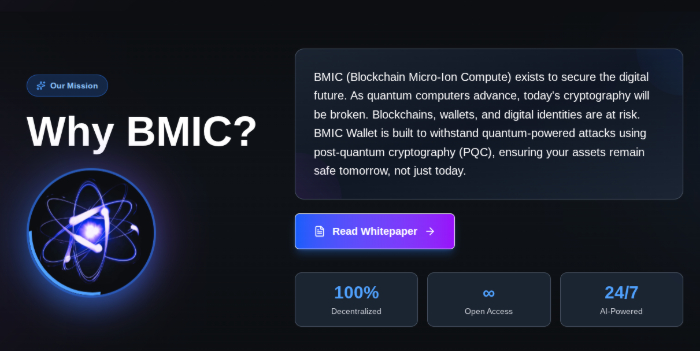
What is the core of this defense? “Zero public key exposure”. This feature prevents the user's public key from being exposed during transactions, effectively defeating the HNDL attack vector.
This technical foresight is critical to extending the longevity of the cryptocurrency ecosystem. Once prediction markets become a “source of truth” on global events, they cannot compromise the financial health of participants. BMIC's “AI-enhanced threat detection” integration creates a proactive shield (rather than a reactive patch) to identify anomalies in transaction patterns before they can be exploited.
For businesses and developers building the next generation of financial apps, this means moving to a “secure by design” foundation.
Explore the first quantum proof ecosystem: BMIC
Presale data suggests demand for defense infrastructure
While the market is chasing volatility in predictive tokens, smart money appears to be hedging against infrastructure moves. The flow of funds into BMIC's presale suggests a growing awareness of quantum risk among forward-looking investors, as the project has already raised more than $432,000.
$BMIC can be purchased for $0.049474. This reflects an early entry point into what could become a standard requirement for digital asset storage. However, the utility of the $BMIC token goes beyond simple governance.
This serves as the ecosystem fuel for the quantum metacloud and is essential to the platform’s secure staking mechanism. Unlike traditional staking, which often requires hot wallet connections that increase vulnerability, BMIC introduces quantum-secure staking without exposing the keys.
The project roadmap also includes a “Burn-to-Compute” mechanism and ERC-4337 smart accounts. This is in line with Ethereum's push for account abstraction, but adds a heavy layer of security on top. It's no surprise to see why $BMIC has become one of our best cryptocurrency presales.
The story is clearly changing. It's moving from “how fast can I trade” (facilitated by new tools at Crypto.com) to “how safe is it to hold for the long term?”
Infrastructure projects like BMIC stand to capture value from that change. The priority is securing a digital future before quantum threats become a current reality.
To future-proof your portfolio, check out the official $BMIC site
This article is for informational purposes only and does not constitute financial advice. Investing in cryptocurrencies, including pre-sales and prediction markets, involves a high degree of risk. Please be sure to perform your own due diligence before investing.
