

Altcoin season was widely expected to arrive in 2025, but the reality was very different. Instead of a widespread rally, most altcoins suffered significant and prolonged declines, erasing years of gains and forcing many investors out of the market.
As 2026 approaches, sentiment around altcoins remains fragile. A growing number of analysts are now warning that the worst may not be over, arguing that structural weaknesses, declining liquidity and declining retail participation could cause stocks across the sector to fall further.
Related books
Market data supports this cautious outlook. The market capitalization of crypto assets excluding the top 10 assets, commonly referred to as the OTHERS index, has fallen by more than 50% since December 2024. Market capitalization has fallen from about $451 billion to about $182 billion in just 12 months, highlighting the scale of capital destruction across small and mid-cap tokens.
This sharp contraction reflects active risk aversion, weak demand, and sustained selling pressure across the altcoin market.
However, not all analysts are convinced that the altcoin cycle is over. A smaller group points to historical precedent, arguing that strong recoveries in altcoins were often preceded by periods of extreme underperformance and investor capitulation. From this perspective, the altcoin season could arrive later in 2026 if the liquidity situation improves and capital rotation resumes.
Altcoin trading activity remains strong despite price slump
A recent CryptoQuant report challenges the widely held belief that this cycle “there is no season for altcoins.” Data shows that concentrated exchange trading volumes for altcoins, excluding the top five assets, have reached significantly higher levels than seen in past market cycles. In other words, altcoins are being traded more actively than ever before, even though prices are still significantly depressed in large parts of the market.

This discrepancy in volume and price helps explain the general confusion. Although many tokens have lost a significant portion of their value, on-chain and exchange data shows that activity has not disappeared. Instead, the market experienced a structural shift.
After months of losses, retail investor participation significantly waned, with many small investors giving in and exiting their positions. However, their absence did not result in a decline in overall trading activity.
CryptoQuant analysis suggests that altcoin dominance is increasingly concentrated among larger players. Whales and professional participants are now taking advantage of periods of low liquidity and weak sentiment to accumulate positions and actively rotate capital, resulting in an increasing share of altcoin trading volume.
Seen from this perspective, the current stage may not indicate the absence of an altcoin cycle, but rather its transformation. If whale-driven positioning continues and broader market conditions improve, these participants are likely to push prices higher to maximize profits.
Related books
Others Market capitalization shows long-term compression
The OTHERS chart, which tracks crypto market cap excluding the top 10 assets, highlights the depth and duration of the ongoing altcoin correction. After reaching nearly $450 billion in late 2024, the market has lost more than half of its value and stabilized around the $200-210 billion zone. This sharp contraction confirms that the altcoin market has experienced a complete reset rather than a shallow decline.
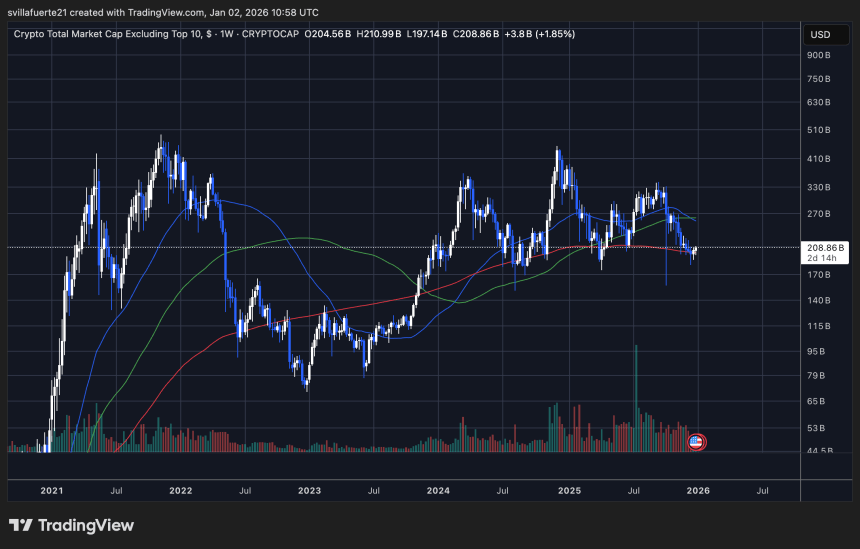
From a technical point of view, this structure reflects compression over time. The price is currently hovering around the 200-week moving average (red). This is the level that has historically served as a long-term equilibrium zone during the transition period between bearish and recovery phases. The failure to reclaim the 100-week and 50-week moving averages suggests that the upward momentum remains weak and buyers lack confidence in higher levels.
Related books
Volume dynamics support this view. Although there are periodic spikes during declines and bailout rebounds, there is no sustained volume expansion that would indicate widespread accumulation. This means selective positioning rather than broad risk appetite.
Importantly, the market is no longer making aggressive lows, indicating that the forced sell-off may be almost over. However, the lack of higher highs keeps the structure neutral to bearish. For altcoins to meaningfully recover, OTHERS needs to regain the $260-$280 billion range and remain above the major moving averages.
Until then, the chart suggests that the market is still looking for a durable bottom rather than consolidation, dominance by large players, and the start of a classic altcoin season.
Featured image from ChatGPT, chart from TradingView.com
