


What you need to know:
Bernstein analysts predict that institutional ETF flows and supply constraints will push Bitcoin to $150,000 in 2026. Bitcoin Hyper leverages the Solana Virtual Machine (SVM) to bring high-speed smart contracts to the Bitcoin network. Whale activity confirms institutional investor interest, with the ongoing presale raising more than $31.3 million. The high asset price of Bitcoin L1 has historically led users to seek scalable layer 2 solutions that enable cheaper transactions.
Bernstein's latest prediction has reignited institutional investor enthusiasm for Bitcoin to reach $150,000 in 2026.
Analysts at the firm, including Gautam Chughani, point to an “unprecedented institutional adoption cycle” driven by spot ETF inflows and a post-halving supply shock as a key driver. This is not just a price target. This is a signal that the asset class is graduating from speculative retail to sovereign-grade Treasury reserves.
But there's a catch. Six-digit Bitcoin poses a distinct second-order problem: scalability. Base layer transaction fees have historically risen as network valuations have ballooned. The main chain becomes impractical except for large-scale payments. This leaves a gap in Layer 2 infrastructure, the protocol that inherits Bitcoin's security while handling the heavy lifting.
Smart money is already at the forefront of this infrastructure crisis. While Bitcoin is consolidating, funds are actively rotating into scalability solutions designed to unlock dormant liquidity.
This change can be seen in the rapid rise of Bitcoin Hyper ($HYPER), a new high-performance layer 2 project that has already secured over $31 million in funding. The theory is simple. If Bitcoin becomes a global vault, protocols like Bitcoin Hyper will establish themselves as fast rails for moving cash.
Learn more about $HYPER here.
Blending the speed of SVM with the security of Bitcoin
The current Bitcoin Layer 2 environment is crowded. However, Bitcoin Hyper ($HYPER) is carving out a specific niche by incorporating the Solana Virtual Machine (SVM) directly into Bitcoin's payments layer. Most existing solutions face a tough trade-off between being secure but slow, or fast and centralized.
Using SVM, Bitcoin Hyper aims to deliver the execution speeds developers have come to expect from Solana at lightning-fast speeds and low cost, while locking finality into the Bitcoin network.
This technology hybrid attacks the core limitations holding back Bitcoin’s DeFi ecosystem: glacial block times and lack of native smart contract programmability. The protocol enables seamless transfer of $BTC into high-performance environments through a decentralized canonical bridge and modular architecture.
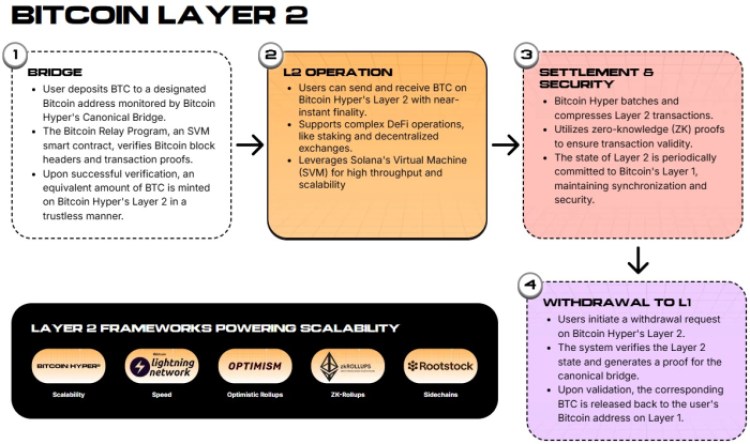
Suddenly, complex DeFi applications, from lending protocols to NFT platforms, are not just possible. It's scalable.
It is important for market dynamics. If Bernstein's $150,000 prediction comes true, there is likely to be a surge in demand for “productive BTC dollars,” assets that are used as collateral rather than sitting idle. Bitcoin Hyper’s approach allows it to act as an execution layer for this liquidity. Developers are particularly interested in a Rust-compatible SDK that lowers the drawbridge for builders transitioning from the Solana ecosystem to Bitcoin liquidity.
$HYPER is available here.
Whale accumulation shows confidence in L2 narratives
The inflow into Bitcoin Hyper’s pre-sale suggests that wealthy investors are betting big on this “SVM vs. Bitcoin” narrative. According to official data, the project raised a staggering $31.3 million. In the current funding environment? Its appearance stands out. The token is priced at $0.0136753 and will attract early backers looking for influence over Bitcoin's main layer movements.

On-chain analysis reveals that this interest is not limited to retailer participants. Etherscan records show that two whale wallets have accumulated over $1 million ($500,000, $379.9K, $274,000) in recent transactions.
The new Layer 2 risk is strong competition from established players such as Stack and emerging zero-knowledge rollups. (Competition is fierce in this field). However, Bitcoin Hyper's staking model provides an attractive incentive structure for securing liquidity. The protocol offers high APY staking immediately after TGE and gives pre-sale participants a short vesting period of 7 days.
This structure rewards long-term alignment with mercenary capital. For investors focused on Bernstein's $150,000 target, $HYPER represents a leveraged bet on the infrastructure needed to support that valuation.
Buy $HYPER here.
Disclaimer: This article is not financial advice. Cryptocurrency is a high-risk asset. The $150,000 Bitcoin prediction is an analyst prediction and is not guaranteed. Please be sure to perform your own due diligence before investing.
