


On-chain data may explain why key price levels are causing problems for Bitcoin.
Related books
Realized prices put a ceiling on the rise
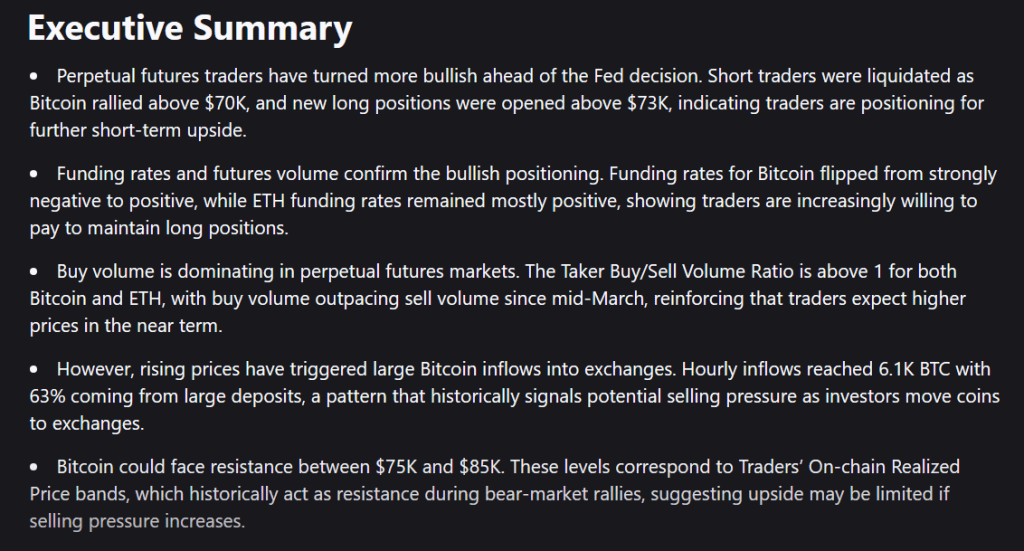
The $75,000 number is more than just a rough number for Bitcoin traders. This is at the lower end of what analysts call “traders' on-chain realized price.” This is an indicator that tracks the average price at which active market participants last moved a coin.
According to Julio Moreno, head of research at CryptoQuant, this band has historically acted as a ceiling for bear markets and appears to be doing the same now.
Bitcoin tested the $75,000 level three times in a 24-hour period on Coinbase, only to be reverted each time.
The rally itself was real. Bitcoin rose about 12% in March, hitting a six-week high of about $76,000 on March 17th. But momentum has stalled just as analysts had warned.
Huge amounts of deposits flow into exchanges
What makes this stall all the more significant is what's happening behind the scenes. On March 16th, hourly Bitcoin inflows into centralized exchanges surged to 6,100 BTC, the highest hourly measurement since February 20th.
Large deposits accounted for more than 60% of that total, the largest share since mid-October 2025, according to the data.
When a trader moves Bitcoin to an exchange, it usually means they are preparing to sell it. Moreno said large spikes in exchange deposits have historically been coupled with increased selling pressure.
It's hard to ignore the exact timing of Bitcoin's resistance.
The question now is whether that selling pressure will be enough to push the price back or whether buyers will absorb it and break through the $75,000 barrier.
Fed decision increases market uncertainty
The broader financial picture adds further complexity. The Fed is scheduled to announce its rate decision on Wednesday, but based on CME futures, traders are pricing in a 98.9% chance that rates will stay where they are, with just a 1.1% chance of a rate hike.
However, holding interest rates unchanged may not be the most market-moving part of this announcement. Reports suggest that the Federal Reserve may signal that there will be no rate cuts at all in 2026, citing continued inflation concerns and the fallout from the U.S.-Iran war. This type of guidance tends to weigh on risk assets.
Related books
More difficult hurdles still lie ahead
Even if Bitcoin manages to clear $75,000 with enough confidence, there are other hurdles ahead higher up.
The fully realized price, which reflects the average break-even level of active traders, is currently around $84,700. This number acted as a resistance level in both October and January.
The starting point is to clear $75,000. Reaching $84,700 will be an entirely different challenge.
Featured image from West Coast Trial Lawyers, chart from TradingView
