

Ethereum is on track to break above the $2,000 level as the broader crypto market weathers deep uncertainty and continued selling pressure. Recent price action reflects a fragile recovery effort rather than a confirmed trend reversal, with volatility remaining high and traders becoming cautious after months of correction. The $2,000 threshold has become an important psychological and technical battleground, shaping short-term sentiment as investors evaluate liquidity conditions, macro signals, and derivatives positioning.
Related books
Recent CryptoQuant analysis provides further insight into evolving market dynamics, particularly in the Ethereum derivatives landscape. Data tracking Binance's estimated leverage ratio shows a clear change in trader behavior. The index recently fell to around 0.557, its lowest reading since December of last year. This decline followed a period of increased leverage, with leverage peaking around 0.675, reflecting a more aggressive risk environment earlier in the cycle.
Declining leverage suggests traders are reducing risk exposure, closing highly leveraged positions, or moving to more conservative strategies. Such transitions often occur during consolidation stages, when markets attempt to stabilize after a spike in volatility.
Decreasing leverage suggests potential for market stabilization
The analyst further notes that the recent decline in Ethereum's estimated leverage ratio reflects a broader reduction in speculative risk across derivatives markets. Low leverage typically indicates that traders are reducing or completely closing highly leveraged positions and shifting to more conservative exposures. Historically, this deleveraging step often preceded the formation of a new price standard, as market participants prioritized capital preservation over short-term speculative profits.

So the drop from about 0.675 to about 0.557 is not just a small technical variation. Rather, it indicates a significant change in market sentiment. Periods characterized by increased leverage tend to amplify volatility and increase the likelihood of sudden liquidations. Conversely, lower leverage generally corresponds to benign market conditions, and price movements are due to underlying demand trends rather than liquidations.
From a medium-term perspective, this transition can be constructive. Lower leverage can create a healthier foundation for price discovery, especially when accompanied by stronger spot demand. In this context, the combination of low leverage readings and relatively stable price movements suggests that the market may be undergoing a phase of consolidation or repositioning. Such an environment often precedes a more definitive directional move when liquidity and sentiment conditions align.
Related books
Ethereum price remains under pressure below major averages
Ethereum continues to trade around $2,000 after a sharp correction following a high in late 2025. The chart shows a clear bearish structure, with prices consistently hitting lower levels since the October peak while failing to sustain a recovery above the major moving averages. Recent stabilization attempts have produced only shallow rebounds, indicating sustained selling pressure and cautious market positioning.
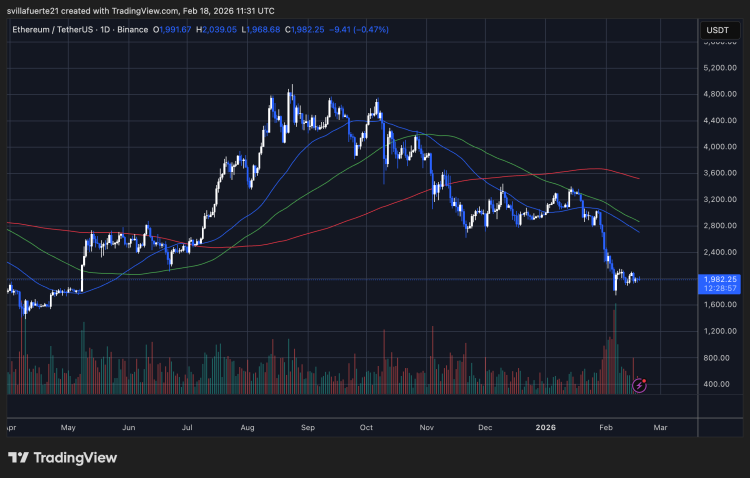
Notably, ETH remains below its short-term, medium-term, and long-term moving averages, all of which are trending downward. This coincidence typically reflects sustained bearish momentum and suggests that the rally may continue to face resistance unless prices are able to decisively regain these levels. The 200-day moving average is currently well above the spot price and stands out as a key structural resistance zone.
Related books
Volume data also provides context. The most recent decline was accompanied by a notable spike in trading activity, often associated with liquidation events and accelerated distribution. Volume has since moderated, consistent with a solid phase rather than an immediate reversal.
From a technical perspective, the $1,900 to $2,000 range currently serves as a short-term stability zone. However, failure to hold this area could expose a lower support level and require a sustained break above nearby resistance to show improved momentum.
Featured image from ChatGPT, chart from TradingView.com
