


Fidelity Digital Assets argues that Bitcoin's market structure has changed enough that the familiar four-year boom-and-bust pattern and brutal 80% drawdowns that often followed it may no longer be the result of default.
The February 24th research note is titled “Is Bitcoin’s 4-year cycle over?” Research analyst Zach Wainwright bases this call on a simple observation. Bitcoin is now a very different sized asset and has a very different set of buyers. Fidelity pegs Bitcoin's market capitalization at a record high of approximately $2.5 trillion as of October 2025, with signs of greater liquidity and more stable volatility than in previous cycles.
“As Bitcoin matures, price trends are starting to diverge from previous cycles. Volatility is decreasing even as the price reaches new highs above $126,000.”
Bitcoin demand is being reshaped
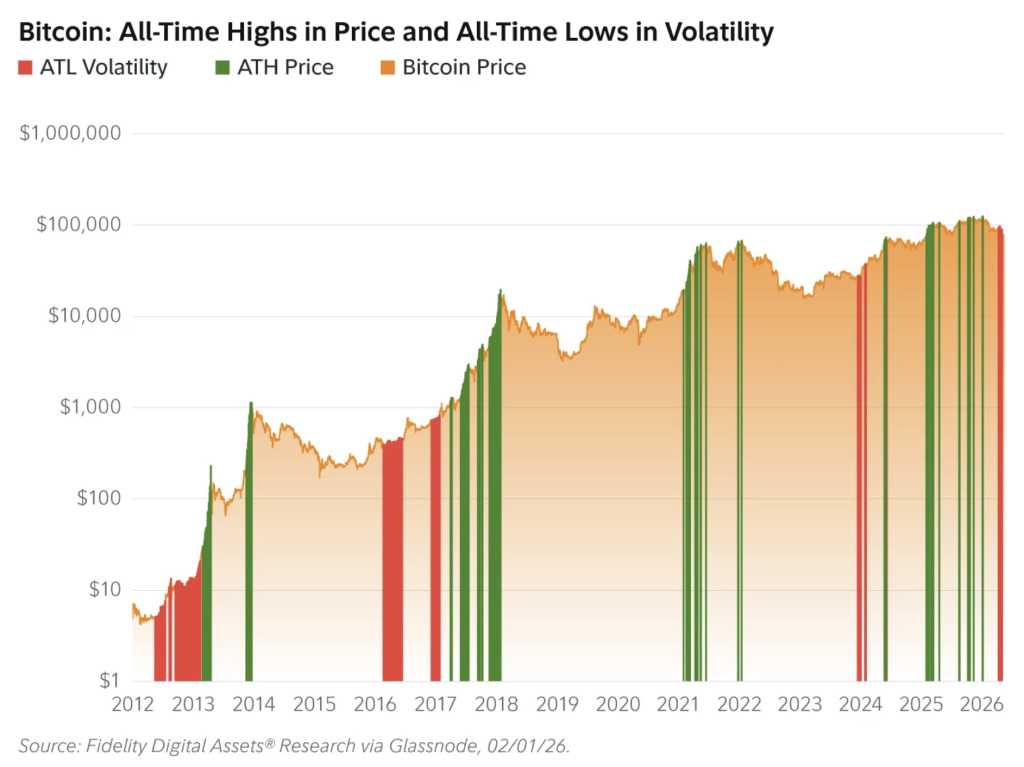
Fidelity's volatility discussion is based on one-year realized volatility and how it behaved near the peak of the cycle. In previous cycles, this pattern has been fairly consistent. Volatility is compressed to new lows before a big rally to new highs, then widens as the cycle heats up.
Related books
This time, Fidelity says post-peak compression will arrive sooner. The note notes that Bitcoin hit its 17th all-time low in one-year realized volatility in January 2026, just months after hitting its all-time high in October 2025, calling it a meaningful departure from the pace of previous cycles. The research team believes that part of the slowdown is due to scale. Bitcoin's market capitalization is approximately double the 2021 peak, approximately 10 times the 2017 peak, and more than 200 times the 2013 peak.
The second pillar is who is holding the supply and how sticky that demand looks. Fidelity highlights a cohort of 49 publicly traded companies that each hold more than 1,000 BTC, with total holdings of more than 1 million BTC and more than 5% of the circulating supply. It also notes that the group's holdings have increased quarter-over-quarter in every quarter since the first quarter of 2020, except for the second quarter of 2022, when Tesla sold the majority of its position.
As for ETFs, the U.S. Spot Bitcoin ETF was launched in January 2024 and held a total of nearly 1.3 million BTC as of January 30, 2026, representing about 6.4% of the circulating supply, Fidelity wrote. The note added that the category leader has surpassed $75 billion in total assets under management in less than two years, a pace that contrasts with gold's flagship ETF, GLD, which took nearly seven years to reach the same milestone.
Together, Fidelity says publicly traded companies and ETFs now account for nearly 12% of circulating supply, with most of that increase coming after 2023, and the researchers believe changes in demand are structurally important to drawdowns.
Related books
Fidelity also claims that the cycle appears to be “remarkably stable” across several on-chain and issuance-related metrics. Using the return window framework, MVRV will remain at about twice its realized value through most of the bull market, at which point the address's return first exceeds 95% and remains above 95% at the end, rather than spiking 4-6x as in previous cycles, the note said.
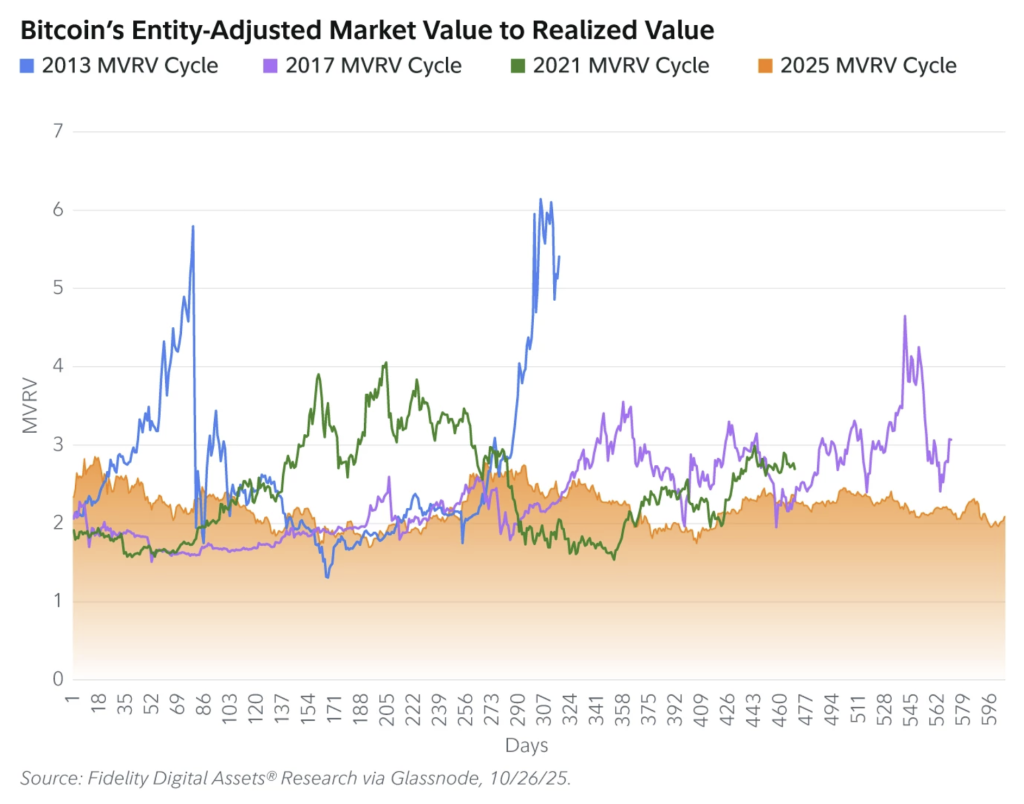
The report presents a counterfactual to illustrate this point. If the market cap reaches four times the realized limit this cycle, that would mean a market cap of approximately $4.5 trillion as of February 2, 2026, or approximately $225,000 per Bitcoin. They also note that the Puel multiple remains near 1, indicating that daily issuance does not deviate significantly from the yearly average.
Fidelity's new “Profit to Volatility Ratio” makes the drawdown case clear. The team has set 0.01 as the stability line, stating that the ratio has remained above 0.015 since late 2023, the longest period at that level in Bitcoin's history. Even though BTC fell below $70,000 due to the economic downturn in February 2026, this ratio remained above the threshold.
“Measurements above 0.01 are considered very stable. Conversely, measurements below 0.01 should be used with caution.”
What Fidelity suggests is not that volatility will disappear, but that a classic end-of-cycle wipeout may become less likely in a market increasingly shaped by institutional channels and larger, more liquid bases. If this regime holds, the next stage could be less like a blow-out of the roof and more like a slower, more systematic pricing approach with prices rising over time but less of a cliff-edge reset.
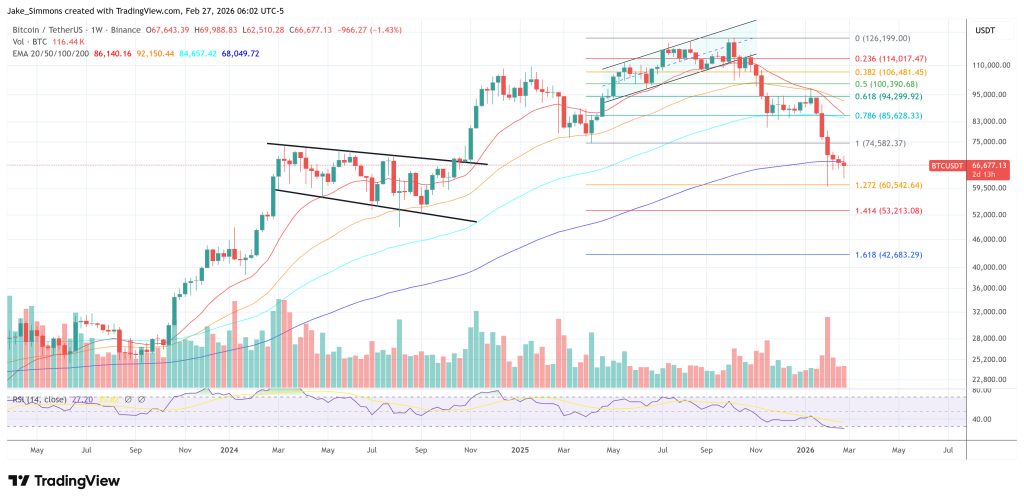
At the time of writing, BTC was trading at $66,677.
Featured image created with DALL.E, chart on TradingView.com
