

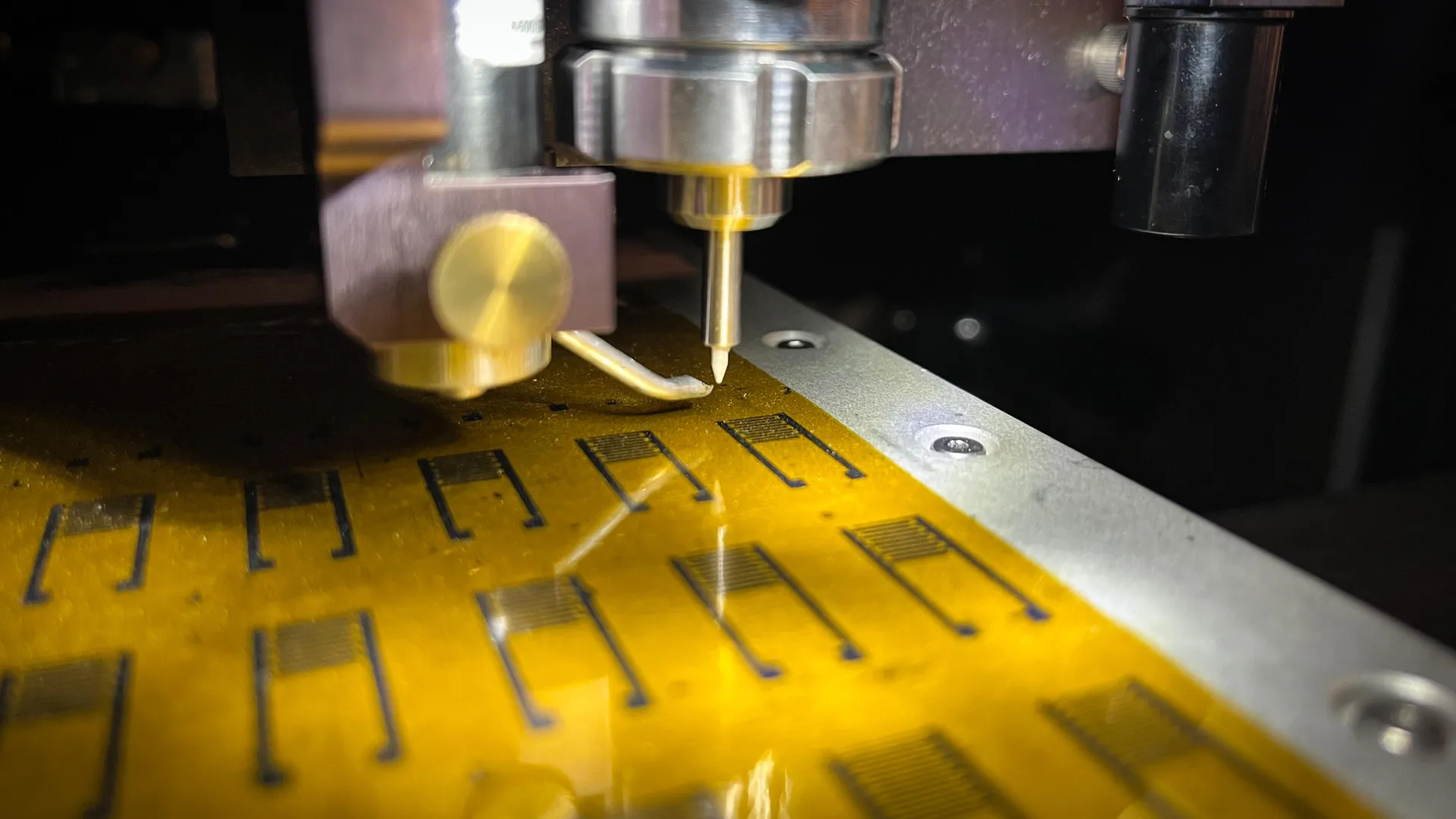
Engineers at Northwestern University have created printed artificial neurons that go beyond imitation and can directly interact with real brain cells. These flexible, low-cost devices produce electrical signals that closely resemble those generated by living neurons, allowing them to activate biological brain tissue.
In experiments using slices of mouse brain, the artificial neurons successfully triggered responses in real neurons. This result shows a new level of compatibility between electronic devices and living neural systems.
Toward Brain Interfaces and Energy-Efficient AI
This advance moves researchers closer to electronics that can directly interface with the nervous system. Potential uses include brain-machine interfaces and neuroprosthetics, such as implants that could help restore hearing, vision, or movement.
The technology also points toward a new generation of computing systems inspired by the brain. By replicating how neurons communicate, future hardware could perform complex tasks using far less energy. The brain remains the most energy-efficient computing system known, and scientists hope to apply its principles to modern technology.
The study will be published on April 15 in the journal Nature Nanotechnology.
“The world we live in today is dominated by artificial intelligence (AI),” said Northwestern’s Mark C. Hersam, who led the study. “The way you make AI smarter is by training it on more and more data. This data-intensive training leads to a massive power-consumption problem. Therefore, we have to come up with more efficient hardware to handle big data and AI. Because the brain is five orders of magnitude more energy efficient than a digital computer, it makes sense to look to the brain for inspiration for next-generation computing.”
Hersam is an expert in brain-inspired computing and holds multiple roles at Northwestern University, including the Walter P. Murphy Professor of Materials Science and Engineering at the McCormick School of Engineering. He also is a professor of medicine at Northwestern University Feinberg School of Medicine and a professor of chemistry at the Weinberg College of Arts and Sciences. In addition, he serves as chair of the department of materials science and engineering, director of the Materials Research Science and Engineering Center, and a member of the International Institute for Nanotechnology. He co-led the study with Vinod K. Sangwan, a research associate professor at McCormick.
Why the Brain Outperforms Traditional Silicon
Modern computers handle increasing workloads by packing billions of identical transistors onto rigid, two-dimensional silicon chips. Each component behaves the same way, and once manufactured, the system remains fixed.
The brain works very differently. It consists of many types of neurons, each with specialized roles, arranged in soft, three-dimensional networks. These networks are constantly changing, forming and adjusting connections as learning occurs.
“Silicon achieves complexity by having billions of identical devices,” Hersam said. “Everything is the same, rigid and fixed once it’s fabricated. The brain is the opposite. It’s heterogeneous, dynamic and three-dimensional. To move in that direction, we need new materials and new ways to build electronics.”
Although artificial neurons have been developed before, most produce overly simple signals. To achieve more complex behavior, engineers typically need large networks of devices, which increases energy use.
Printable Materials Enable Brain-Like Behavior
To better replicate real neural activity, Hersam’s team built artificial neurons using soft, printable materials that more closely match the brain’s structure. Their approach relies on electronic inks made from nanoscale flakes of molybdenum disulfide (MoS2), which acts as a semiconductor, and graphene, which serves as an electrical conductor. These materials were deposited onto flexible polymer surfaces using aerosol jet printing.
Previously, researchers treated the polymer in these inks as a flaw because it interfered with electrical performance. As a result, they removed it after printing. In this work, the team used that same feature to enhance the device.
“Instead of fully removing the polymer, we partially decompose it,” he said. “Then, when we pass current through the device, we drive further decomposition of the polymer. This decomposition occurs in a spatially inhomogeneous manner, leading to formation of a conductive filament, such that all the current is constricted into a narrow region in space.”
That narrow conductive path produces a sudden electrical response similar to a neuron firing. The resulting device can generate a wide variety of signals, including single spikes, continuous firing, and bursting patterns, closely resembling real neural communication.
Because each artificial neuron can produce more complex signals, fewer components are needed to perform advanced tasks. This could significantly improve computing efficiency.
Testing Artificial Neurons on Real Brain Tissue
To evaluate whether the artificial neurons could truly interact with living systems, the researchers partnered with Indira M. Raman, the Bill and Gayle Cook Professor of Neurobiology at Weinberg. Her team applied the artificial signals to slices of mouse cerebellum.
The results showed that the electrical spikes matched key biological properties, including their timing and duration. These signals reliably activated real neurons and triggered neural circuits in a way similar to natural brain activity.
“Other labs have tried to make artificial neurons with organic materials, and they spiked too slowly,” Hersam said. “Or they used metal oxides, which are too fast. We are within a temporal range that was not previously demonstrated for artificial neurons. You can see the living neurons respond to our artificial neuron. So, we’ve demonstrated signals that are not only the right timescale but also the right spike shape to interact directly with living neurons.”
Low-Cost, Sustainable Manufacturing and AI Implications
Beyond performance, the new approach offers environmental and practical advantages. The manufacturing process is simple and inexpensive, and the additive printing method places material only where it is needed, reducing waste.
Improving energy efficiency is especially important as artificial intelligence systems grow more demanding. Large data centers already consume vast amounts of power and require significant water for cooling.
“To meet the energy demands of AI, tech companies are building gigawatt data centers powered by dedicated nuclear power plants,” Hersam said. “It is evident that this massive power consumption will limit further scaling of computing since it’s hard to imagine a next-generation data center requiring 100 nuclear power plants. The other issue is that when you’re dissipating gigawatts of power, there’s a lot of heat. Because data centers are cooled with water, AI is putting severe stress on the water supply. However you look at it, we need to come up with more energy-efficient hardware for AI.”
The study, “Multi-order complexity spiking neurons enabled by printed MoS2 memristive nanosheet networks,” was supported by the National Science Foundation.
